Wednesday, June 25, 2014

What is Leverage? in forex trading

by Jeremy Wagner, Head Forex Trading Instructor
Leverage is a financial tool that allows an individual to increase their market exposure to a point that exceeds their actual investment. For example, a trader goes long 10000 units of the USD/JPY, with $1,000 dollars of equity in their account.
The USD/JPY trade is equivalent to controlling $10,000. Because the trade is 10 times larger than the equity in the trader’s account, the account is said to be leveraged 10 times or 10:1.
What_is_Leverage_body_Picture_2.png, What is Leverage?
Had the trader bought 20,000 units of the USD/JPY, which is equivalent to $20,000, their account would have been leveraged 20:1.
What_is_Leverage_body_Picture_1.png, What is Leverage?
Leverage allows an individual to control larger trade sizes. Traders will use this tool as a way to magnify their returns. It’s imperative to stress, that losses are also magnified when leverage is used. Therefore, it is important to understand that leverage needs to be controlled.
FXCM provides flexible leverage to its clients. You can trade with no leverage at all, or you can trade with a significant amount of leverage.
FXCM believes clients have a greater chance of long-term success when a conservative amount of leverage, or even no leverage, is implemented.
Here is a recent study completed of thousands of FXCM accounts (“Traits of Successful Traders: How Much Capital Should I Trade Forex With?”). What we found out is that when traders used more conservative amounts of effective leverage, the percentage of profitable traders increased. Traders should look to use effective leverage of 10 to 1 or less.

The Long and Short of Forex

by James Stanley, Forex Trading Instructor
Aspiring traders will often be familiar with the concept of buying to initiate a trade. After all, since many of us are children we are taught the basic premise of ‘buying low, and selling high.’
In financial markets, jargon often plays a key role. Jargon helps show familiarity and comfort with a particular subject matter, and nowhere is this jargon more apparent than when discussing the ‘position,’ of a trade.
When a trader is buying with the prospect of closing the trade at a higher price later, the trader is said to be going ‘Long,’ in the trade. The following graphic will illustrate the dynamic of a long position:
The_Long_and_Short_of_It_body_x0000_i1026.png, The Long and Short of it
Created on Marketscope with Trading Station
While this premise may seem easy enough, the next may be slightly more unconventional to new traders.
The concept of selling something that isn’t already owned may prove as a confusing concept, but in their ever-evolving pragmatism traders created a mannerism for doing so.
When a trader is going ‘Short,’ in a trade, they are selling with the goal of buying back (to cover the trade) at a lower price. The difference between the initial selling price, and the price at which the trade was ‘covered,’ is the traders profit to keep less any fees, commissions, or selling expenses. The chart below illustrates a ‘Short,’ position.
The_Long_and_Short_of_It_body_Picture_2.png, The Long and Short of it
Created on Marketscope with Trading Station
It’s important to note the interesting distinction between currencies and other markets. Because currencies are quoted with two sides (each quote references 2 different currencies taking opposing positions), each trade offers the trader long and short exposure in varying currencies.
For example, a trader going short EUR/AUD would be selling Euro’s and going long Australian Dollars. If, however, the trader went long the currency pair – they would be buying Euro’s and selling Australian Dollars.

Forex Currency Names and Symbols

by Richard Krivo, Trading Instructor
As you may have noticed, the symbols (abbreviations) for all currencies have three letters. The first two letters denote the name of the country and third letter stands for the name of that country’s currency.
As an example, let’s look at the USD. The US stands for United States and the D stands Dollar.
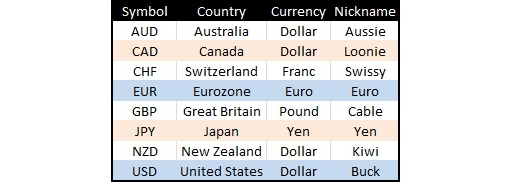
The currencies on which the majority of traders focus are called the “majors”. The most widely traded currencies are represented on the grid below:
Currency_Names_and_Symbols_body_Picture_3.png, Currency Names and Symbols
Not to be confused with major currencies are the major currency pairs. The Major Pairs are any currency pair with USD in them. For example, the EURUSD would be considered a Major Pair.
Currency_Names_and_Symbols_body_Picture_2.png, Currency Names and Symbols
Currency pairs without the USD in them are referred to as Cross Pairs. The EURJPY would be an example of a Cross Pair.
Currency_Names_and_Symbols_body_Picture_1.png, Currency Names and Symbols
To carry this one step further, any EUR pair without the USD in it would be referred to as a Euro Cross. So the EURJPY would be a member of the EURO Cross group. Other member of that group would be EURGBP, EURCHF, EURNZD, EURCAD and EURAUD.
Other currency groups of this type would be comprised of the JPY crosses, GBP crosses, AUD crosses, NZD crosses and the CHF crosses.

The Basics of How Money is Made Trading Forex

by Richard Krivo, Trading Instructor
PreviousWhat is Forex?
Trading currency in the Forex market centers around the basic concepts of buying and selling.
Let's take the idea of buying first. What if you bought something (it could literally be almost anything...a house, a piece of jewelry or a stock) and it went up in value. If you sold it at that point, you would have made a profit...the difference between what you paid originally and the greater value that the item is worth now.
Currency trading is the same way...
Let's say you want to buy the AUDUSD currency pair. If the AUD goes up in value relative to the USD and then you sell it, you will have made a profit. A trader in this example would be buying the AUD and selling the USD at the same time.
For example if the AUDUSD pair was bought at 1.0615 and the pair moved up to 1.0700 at the time that the trade was closed/exited, the profit on the trade would have been 85 pips. (See the chart below…)
The_Basics_of_How_Money_is_Made_Trading_FX_body_audusd_buy_2_22.png, The Basics of How Money is Made Trading Forex
Had the pair moved down to 1.0600 before the trade was closed, the loss on the trade would have been 40 pips.
Also, it makes no difference which currency pair you are trading. If the price of the currency you are buying goes up from the time you bought it, you will have made a profit.
Here is another example using the AUD. In this case we still want to buy the AUD but let’s do this with the EURAUD currency pair. In this instance we would sell the pair. We would be selling the EUR and buying the AUD simultaneously. Should the AUD go up relative to the EUR we would profit as we bought the AUD.
In this example if we sold the EURAUD pair at 1.2320 and the price moved down to 1.2250 when we closed the position, we would have made a profit of 70 pips. Had the pair moved up instead and we closed out the position at 1.2360 we would have had a loss of 40 pips on the trade.
Remember, we are always buying or selling the currency on the left side of the pair. If we buy the currency on the left side, which is called the base currency, we are selling the one on the right side which is called the cross or counter currency. The opposite would be true if we were selling the currency on the left side.
Now let's take a look at how a trader can make a profit by selling a currency pair. This concept is a little trickier to understand than buying. It is based on the idea of selling something that you borrowed as opposed to selling something that you own.
In the case of currency trading, when taking a sell position you would borrow the currency in the pair that you were selling from your broker (this all takes place seamlessly within the trading station when the trade is executed) and if the price went down, you would then sell it back to the broker at the lower price. The difference between the price at which you borrowed it (the higher price) and the price at which you sold it back to them (the lower price) would be your profit.
For example, let’s say a trader believes that the USD will go down relative to the JPY. In this case the trader would want to sell the USDJPY pair. They would be selling the USD and buying the JPY at the same time. The trader would be borrowing the USD from their broker when they execute the trade. If the trade moved in their favor the JPY would increase in value and the USD would decrease. At the point where they closed out the trade, their profits from the JPY increasing in value would be used to pay back the broker for the borrowed USD at the now lower price. After paying back the broker, the remainder would be their profit on the trade.
For example, let’s say the trader shorted the USDJPY pair at 76.28. If the pair did in fact move down and the trader closed/exited the position at 75.81, the profit on the trade would be 47 pips.
The_Basics_of_How_Money_is_Made_Trading_FX_body_usdjpy_2_22.png, The Basics of How Money is Made Trading Forex
On the other hand, if the pair was shorted at 76.28 and the pair did not move down but rather it moved up to 76.50 when the position was closed, there would be a loss on the trade of 22 pips.
In a nutshell, this how you can make a profit from selling something that you do not own.
In wrapping up, if you buy a currency pair and it moves up, that trade would show a profit. If you sell a currency pair and it moves down, that trade would show a profit.

What is Forex?

by Jeremy Wagner, Head Forex Trading Instructor
What is forex? Why trade forex?
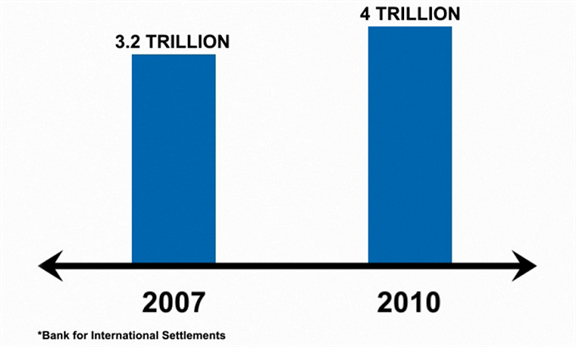
The foreign exchange market – or forex for short – is the buying and selling of currencies, and it’s one of the fastest growing markets in the world. From 2007 to 2010, forex market activity increased by 20%, with average daily turnover reaching nearly $4 trillion in April of 2010.
What_is_Forex_body_Picture_2.png, What is Forex?
Forex trading works much like it does with stocks, you buy low and you sell high. The benefit of trading forex is that you don’t have to choose from thousands of companies or sectors. Plus, you can make things even simpler than choosing which company to buy.
For example, most people, even those that are new to forex, have an opinion on the US dollar and the US economy. They can easily take their opinions and translate them into a forex trade. Buying or selling US Dollars as simple as they buying or selling a company’s stock.
Also, another advantage of the FX market is that it doesn’t begin at 9AM and end at 4PM. Trading takes place 24 hours a day, 5 days a week. For most people 24 hour trading means they can trade before or after work. Plus, you have the flexibility to make your trades online.
What_is_Forex_body_Picture_1.png, What is Forex?
Plus, you can buy and sell at any time, in up trends (also called bull markets) and in down trends (also called bear markets).

It’s easy to get started. You can sign up for a free demo with FXCM and get $50,000 of virtual money to practice trading online with one of FXCM’s easy to use trading platforms, including mobile and tablet offerings. At FXCM we provide all the educational resources and trading tools you need to go from practice trading to real trading. Online educational seminars and a suite of video lessons are only a few examples.

Tuesday, August 20, 2013

Learn the Reality of Surviving the Forex Market

The foreign exchange is a favorite haunt of day traders. The volatility means that it would seem that anyone could make a fortune in a short time. The reality is that you need practice, patience, and perseverance to make a living in this profession. Read on to learn the basics of trading in this tough market.

Keep an eye on all the markets, not just Forex. What happens there will affect the Forex market as well, so tracking outside trends can help you anticipate Forex fluctuations. Since these small changes are critical to your success, you can’t afford to ignore the world around you.

Never, ever invest money you can’t afford to lose. Even the best strategies will you fail you sometimes, so trading with your rent money will probably leave you high and dry. Carefully research and plan each trade to minimize your risk while maximizing potential profits. Balancing the risk vs. reward equation is vital to your success in the market.

While the traditional image of a day trader is someone who is hot-headed and ready to take risk, these are not the people who usually make the most money. While it does not make a good public figure, the best traders are patient and have amazing self control. The impulses that helped humans survive as a species actually hurt profits in the Forex market. You will need to learn to control these instincts if you want to succeed.

Learn stress management techniques. They will help you keep your head, even when things are not going your way. If you become impatient or fearful during a bad streak you will make even bigger mistakes increasing your loses. You need to learn to control your emotions and stick to your strategies. If they are good they will allow you to rebuild from failure and increase your profits even further.

Learn the basics before you jump in. The best traders have spent years building up an arsenal of techniques that allow them to profit regardless of market trends. Fortunately, most Forex brokers allow you to practice trading with a dummy account before you start spending real money. This is an opportunity to learn to spot trends and practice strategies. Never put real money on the line until you are confident in your abilities.

Decide on a set of goals for yourself, and work to achieve them. Of course, becoming a millionaire in a month is probably not a good place to start. However, reasonable, well-thought out goals can help you stay focused even when things aren’t going your way. Start with something small like generating a percentage of your total income or paying off a few bills, and go from there.

Forex trading is a good way to make a living. If you can handle the pressure you can achieve a very comfortable life with this simple job. Now that you’ve learned the basics, it’s time to do some research and start practicing. It will not be long before you can start bringing home plenty of money to feed your family and enjoy a few extras as well.


How To Become A Successful Forex Trader


Are you thinking about becoming a forex trader? You should go over this article to learn more about forex and how to become a successful trader.


Becoming a successful trader could take you years. You should start by educating yourself about forex and trading in general, practice with small investments and learn from your mistakes. It might take years before you can earn a good living thanks to your work as a trader. Do not approach forex with unrealistic expectations and keep in mind that you will eventually be successful if you are patient and ready to persevere. Forex is becoming more popular and a large number of people try becoming traders but remember that only a small percentage invests enough time and efforts to become a professional.

Explore the two main forex analysis systems. Some traders rely on fundamental analysis, which is based on observing the economical and political situations of a country to deduct currency fluctuations. Technical analysis is based on mathematical formulas that allow traders to recognize patterns and make predictions based on previous occurrences. Both methods have their pros and cons but you should focus on the one you are the most comfortable with.

Learn to manage your available funds smartly. You should avoid investing more than sixty percent of your funds at once to prevent major losses. Look for several smaller safe investment to increase your chances of making a profit. The best way to maximize your profits is to increase your best investments once you have solid reasons to believe their value will keep going up. Avoid losses by establishing a selling point for each investment, so you can get your money back before the investment loses its original value.

Find experienced traders who can help you. You can learn a lot from following the analyses and predictions of professional traders and even talking with them directly on forums or social media. Keep in mind that forex is becoming increasingly popular, and many people are posing as successful traders to sell products to novices. Do not trust anyone who cannot prove they are a successful trader. And keep in mind that the best traders will never reveal all their secrets.

The best way to invest on the forex platform is to establish a detailed strategy and follow it regardless of how the market evolves. When you find an interesting investment, assess your risks, look at reliable predictions from professionals who are usually right and decide how much you can afford to risk. Calculate a selling point to get your money back before the investment loses its original value and decide which profit range you will be satisfied with. Follow your original plan since you might not be able to make rational decisions if you feel greedy or stressed because you are worried about losing money.

Are you ready to start your education to become a successful trader and earn a living thanks to forex? You should take your time and do not let small failures discourage you.